
Drivers searching for no-credit-check buy now pay later car insurance are usually concerned about two separate issues: whether credit information may affect an auto insurance quote and whether the premium can be divided into smaller payments.
Those issues should be evaluated separately. A monthly payment arrangement does not automatically eliminate a credit-based insurance review, and an insurer that does not use credit information may still require an initial premium payment before coverage begins.
Coverage reminder: A quote, submitted application, payment receipt, or confirmation screen is not automatically proof of active insurance. Before driving, confirm that the insurer or licensed producer has issued a binder, policy, insurance card, or other valid evidence showing the insured vehicle and exact effective date and time.[1]
Commercial disclosure:
Buynowpaylatercarinsurance.com is an independent information and comparison website, not an insurance company, agency, broker, lender, credit bureau, or underwriting carrier. The site may connect visitors with independent third-party quote providers or insurance-listing services and may receive compensation after a click, referral, or completed form. Results may not include every insurer or policy available in a state.
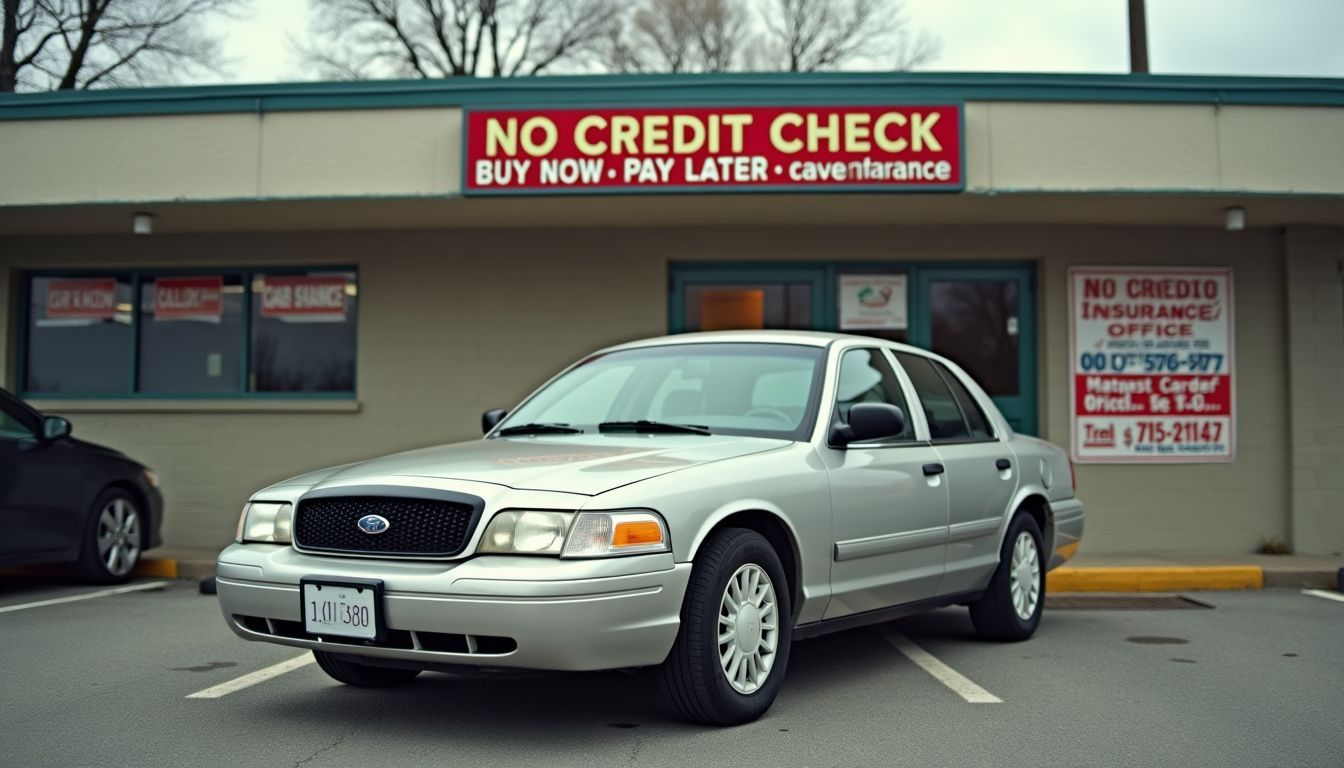
What “No Credit Check” Can Mean in Auto Insurance
“No credit check car insurance” is not a standardized coverage type. It is generally an advertising or search phrase used by consumers who want an insurer that does not use credit information, or who want credit to have less effect on pricing.
Whether an insurer may use credit information depends on state law and company practices. The NAIC reports that many auto and homeowners insurers use credit-based insurance scores in underwriting or rating, while state regulators impose different restrictions and consumer protections.[2]
Some states prohibit or tightly limit the practice. Massachusetts, for example, prohibits auto insurers from using credit information from consumer reporting agencies for underwriting or rating.[3] Texas permits regulated use of insurance credit scores and provides state-specific consumer protections.[4]
Because state rules differ, consumers should not rely on a nationwide “no credit check” promise without confirming the applicable law and the insurer’s actual rating and underwriting practices.
Credit Score vs. Credit-Based Insurance Score
A consumer credit score is generally designed to predict credit behavior, such as the likelihood that a borrower will repay a debt. A credit-based insurance score is a different model used by some insurers to estimate insurance risk. The two scores may use overlapping credit-report information, but they are not necessarily calculated the same way or used for the same purpose.
| Score or information | Common purpose | What consumers should know |
|---|---|---|
| Consumer credit score | Helps lenders assess credit risk for loans, credit cards, and other credit products. | The score is based on information in a credit report and can change as the underlying information changes. |
| Credit-based insurance score | May be used by an insurer as one factor in underwriting or rating where state law allows. | It is not necessarily the same number used by a lender, and insurer models and state restrictions vary. |
| Specialty insurance report | May contain claims, loss history, driving-record, or other insurance-related information. | Consumers can request applicable reports and dispute inaccurate information. |
The NAIC explains that credit-based insurance scores are not the same as ordinary credit scores and can consider factors such as payment history, outstanding debt, length of credit history, new credit activity, and credit mix.[5]
Checking your own credit report does not mean that an insurer will use the same score or give a specific price. It can still help you identify errors before shopping.
What Insurers May Consider Besides Credit
Auto insurers generally use several rating and underwriting factors. The exact formula differs by insurer and state, but common considerations can include:
Driver history
- Driving experience
- Accidents and claims
- Traffic violations
- Prior insurance and coverage gaps
Vehicle and use
- Vehicle year, make, model, and value
- Safety and repair characteristics
- Annual mileage
- Personal, commuting, or business use
Location and policy choices
- Garaging location
- Household drivers
- Coverage limits
- Deductibles and optional coverages
Texas regulators, for example, list driving record, claims history, location, mileage, vehicle cost, and credit score among factors that may affect auto insurance costs. Company formulas differ, and another state may prohibit or restrict some factors.[6]
Credit Review and Monthly Billing Are Separate Issues
The way an insurer calculates or underwrites a policy is separate from the way the premium is billed. An insurer may offer installments even when it uses a credit-based insurance score. Another insurer may not use credit information but may still require a substantial amount before coverage begins.
| Payment arrangement | How it generally works | What to verify |
|---|---|---|
| Pay in full | The entire premium is paid at the beginning of the policy term. | Whether this avoids installment charges or qualifies for a discount. |
| Insurer installment billing | The insurance company divides the premium into scheduled payments. | Initial amount, number of installments, billing charges, due dates, and autopay terms. |
| Reduced initial payment | A smaller portion of the premium is collected before coverage begins. | Whether later installments are larger and what the full policy will cost. |
| Premium financing | A separate lender finances the insurance premium and the policyholder repays the lender. | Interest, finance charges, cancellation authority, refund handling, and total repayment. |
A premium-financing agreement is different from ordinary monthly insurer billing because it can create a separate lending contract with its own fees and cancellation rights.
Readers who want a broader explanation of payment structures can review the site’s guide to flexible premium-payment options .
Compare the Full Cost, Not Only the First Payment
A smaller payment due today can improve short-term cash flow, but it does not necessarily reduce the total cost. Request a written schedule showing every payment and charge.
- Total policy premium: the amount charged for the insurance coverage.
- Installment or billing charge: a possible charge for dividing the premium into multiple bills.
- Agency or broker charge: a separate charge that may apply where permitted and disclosed.
- Finance charge: a cost connected with a separate premium-financing agreement.
- Returned-payment charge: a possible fee when a bank or card payment is rejected.
- Reinstatement charge: a possible cost associated with restoring a canceled policy.
- Pay-in-full or autopay discount: a possible discount whose availability and conditions vary.
Hypothetical example—not an actual quote:
Assume a six-month policy costs US$1,200 when paid in full. An illustrative installment arrangement could require US$240 initially, followed by five payments of US$200, with an additional US$8 billing charge on each later payment. The installment option would total US$1,240. It lowers the amount due at the beginning but adds US$40 to the total cost.
Actual premiums, discounts, fees, deposits, and payment schedules vary. The example only shows why consumers should add every scheduled payment before comparing options.
A Quote Is Not the Same as Active Coverage
Quote
An estimated price based on information supplied by the applicant. It can change after verification or underwriting.
Binder
A temporary agreement that may provide coverage until the formal policy is issued, subject to its stated terms.
Policy
The contract describing coverage, exclusions, responsibilities, limits, deductibles, and the policy period.
Coverage should not be treated as active until the insurer or licensed producer confirms the effective date and time and provides valid documentation. A quote platform may collect information or connect a consumer with another company without issuing the policy itself.
The site’s explanation of the quote and activation process provides more detail about the steps between requesting a price and receiving insurance documents.
What to Do If a Consumer Report Affects the Decision
Insurance companies may obtain information from nationwide credit bureaus or specialty consumer reporting companies. Specialty reports can contain auto claims, property claims, loss history, driving records, or related information used in insurance decisions.[7]
If an insurer takes an unfavorable action based in whole or in part on a consumer report, the consumer may receive an adverse action notice identifying the reporting company. The CFPB explains that a consumer can request a free copy of the report identified in the notice and review it for errors.[8]
Steps for reviewing report information
- Read the adverse action or pricing notice carefully.
- Identify the consumer reporting company named in the notice.
- Request the report within the applicable period.
- Review names, addresses, accounts, claims, losses, and driving information for errors.
- Dispute inaccurate or incomplete information directly with the reporting company.
- Keep copies of the notice, report, dispute, and response.
- Ask the insurer whether corrected information can be reconsidered under applicable rules.
Consumers can also obtain free credit reports through the federally authorized source identified by the CFPB and FTC. Requesting your own report does not itself lower your credit score.[9]
Accurate negative information generally cannot be removed simply because it is unfavorable. Be cautious of companies promising to erase correct information or create a new credit identity.
Coverage Still Matters More Than the Credit Label
A policy described as no credit check is not automatically affordable or adequate. Compare quotations using the same drivers, vehicles, limits, deductibles, and endorsements.
Liability coverage
Generally helps pay for covered injuries or property damage the insured causes to other people, up to the policy limits.
Collision coverage
Generally helps pay for covered collision damage to the insured vehicle, subject to the deductible and contract terms.
Comprehensive coverage
Generally covers specified non-collision losses such as theft, fire, vandalism, weather, or animal damage, subject to exclusions and a deductible.
“Full coverage” is an informal expression rather than a standardized policy name. It commonly refers to liability combined with collision and comprehensive, but it does not mean every loss, driver, vehicle, or situation is covered.
State-required liability limits may be lower than the amount needed after a serious accident. Optional coverage such as uninsured or underinsured motorist protection, medical payments, or personal injury protection can also vary by jurisdiction.
The NAIC notes that a lender or leasing company may require collision and comprehensive coverage for a financed or leased vehicle.[10]
Financed or leased vehicle: Review the loan or lease before removing physical-damage coverage or increasing deductibles. Failure to maintain required coverage can lead a lender to purchase coverage that mainly protects its own interest and add the cost to the vehicle account.
Missed Payments, Cancellation, and Reinstatement
Credit practices do not change the obligation to pay the premium. A missed, rejected, or late installment can result in a fee, cancellation notice, lapse, or another action allowed by the policy and state law.
Consumers should not assume that every policy provides a grace period. Cancellation notice requirements, payment deadlines, and reinstatement rules vary by state and policy.
Act quickly after a payment or cancellation notice
- Read the stated cancellation date and time.
- Contact the insurer or licensed agency through verified contact information.
- Ask whether payment will prevent cancellation or only allow reinstatement.
- Confirm whether a lapse has already occurred.
- Request written proof of reinstatement and its effective date and time.
- Arrange replacement coverage before the current policy ends when reinstatement is unavailable.
- Do not drive during a period when coverage cannot be confirmed.
A payment submitted after cancellation does not necessarily restore insurance retroactively. A reinstated or replacement policy may begin later, leaving an uninsured period.
If a policy is canceled before the end of its term, ask how any unearned premium, nonrefundable fees, finance balance, and refund will be handled.
How to Verify an Insurer or Producer
The name of a comparison site or advertisement may not be the same as the legal name of the insurance company underwriting the policy.
Verify licensing
Confirm that the insurer and any agent, producer, or agency are authorized in the applicable state.
Identify the carrier
Use the exact underwriting company name shown on the quote, binder, declarations page, or policy.
Research responsibly
Consider licensing, complaints, financial condition, company size, coverage, and service—not one metric alone.
The NAIC provides a directory for locating state insurance departments, verifying agents, and finding complaint assistance.[11]
Confirm who issues the policy, who collects the premium, who services billing, and who handles claims and cancellation questions before paying.
Information Commonly Needed for a Quote
Drivers
- Names and dates of birth
- Driver’s license information
- Accidents and violations
- Household driver details
Vehicles
- Year, make, model, and VIN
- Ownership or financing status
- Garaging address
- Use and estimated mileage
Coverage and history
- Current or prior insurer
- Coverage limits and deductibles
- Claims history
- Prior coverage gaps
Provide complete and accurate information. An initial price can change after records are verified, and material omissions can create underwriting or claim problems.
Checklist Before Choosing a Policy
- Does the insurer use credit information or a credit-based insurance score in my state?
- Which consumer reporting company or model is used?
- What rights or notices apply if report information affects the decision?
- What is the exact legal name of the underwriting insurer?
- Is the insurer and producer licensed in my state?
- What is the complete premium for the policy term?
- Exactly how much must be paid before coverage begins?
- What installment, agency, broker, finance, or returned-payment charges apply?
- Are the coverage limits and deductibles suitable for my situation?
- Does my loan or lease require collision, comprehensive, or specific deductibles?
- What is the exact effective date and time?
- What happens after a late or rejected payment?
- How will cancellation, reinstatement, and any refund be handled?
- Have I received a binder, policy number, declarations page, or valid insurance card?
Frequently Asked Questions
Does no credit check mean the insurer ignores all financial information?
Not necessarily. The phrase is not standardized. Ask whether the insurer uses a credit-based insurance score, another consumer report, prior payment history, or different underwriting information.
Is a credit-based insurance score the same as my lending credit score?
No. The models may use some of the same credit-report information, but they are designed for different purposes and may produce different numbers.
Can an insurer use credit information in every state?
No. State rules differ. Some states prohibit the practice for auto insurance, while others permit it with restrictions and disclosure requirements.
Does monthly billing mean there is no credit review?
No. Billing and underwriting are separate. An insurer can offer monthly installments and still use credit information where permitted.
Does no credit check mean nothing is due at the start?
No. The insurer may still require an initial premium payment before coverage becomes effective.
Will installment payments cost more?
They can. Billing, installment, agency, or finance charges may increase the total amount paid. Compare the sum of every payment with the pay-in-full price.
What can I do if a consumer report contains an error?
Request the report from the company that produced it, review the information, and dispute inaccurate or incomplete items directly with that reporting company. Keep copies of the notice and dispute.
Is an online quote proof that I am insured?
No. Confirm that a binder, policy, insurance card, or other valid documentation has been issued with the correct effective date and time.
Does every policy provide a grace period?
No. Check the policy, billing documents, notices, and applicable state rules rather than assuming late payment is allowed.
How can I confirm that an insurer is legitimate?
Verify the exact underwriting company and producer through the applicable state insurance department. Review licensing, complaint, and financial information together.
How This Guide Was Prepared
This page was prepared as a general U.S. consumer guide. It separates credit-based insurance scoring from premium billing, avoids promising approval or a particular initial payment, and does not rank insurers or claim that one arrangement is best for every driver.
The editorial review considered current consumer information from the National Association of Insurance Commissioners, the Consumer Financial Protection Bureau, the Federal Trade Commission, the Texas Department of Insurance, the Massachusetts Division of Insurance, and the California Department of Insurance.
Because insurance regulation and rating rules vary by state, readers should confirm current requirements and personalized policy details with the insurer, a licensed producer, a lender where applicable, and their state insurance department.
Final Takeaway
No-credit-check buy now pay later car insurance is not one standardized product. The credit question and the payment question should be evaluated separately: determine whether credit information may affect the quote, then compare the full premium, initial payment, installments, fees, coverage, and cancellation terms.
A useful policy should provide suitable protection, come from a licensed insurer, begin at a clearly confirmed time, and remain affordable after the first payment.
References
- California Department of Insurance. Automobile Insurance Terms . Definitions of quotation, binder, policy, premium, and related automobile insurance terminology. ↩
- National Association of Insurance Commissioners. Credit-Based Insurance Scores . Regulatory and consumer background concerning insurer use of credit-based insurance scores. ↩
- Massachusetts Division of Insurance. Basics of Auto Insurance . Massachusetts consumer guidance explaining that credit information may not be used for auto insurance underwriting or rating. ↩
- Texas Department of Insurance. Credit Scoring and Insurance . Texas-specific information about regulated use of insurance credit scores and consumer protections. ↩
- National Association of Insurance Commissioners. Credit-Based Insurance Scores Are Not the Same as Credit Scores . Consumer explanation of common insurance-score factors and distinctions from ordinary credit scores. ↩
- Texas Department of Insurance. How Auto and Homeowners Insurance Costs Are Calculated . Examples of factors that may affect auto insurance pricing. ↩
- Consumer Financial Protection Bureau. Insurance Claims and Specialty Consumer Reports . Information about consumer reports containing claims, loss-history, and driving information. ↩
- Consumer Financial Protection Bureau. Adverse Action and Insurance Consumer Reports . Explanation of adverse action notices, free reports, and correction of errors. ↩
- Consumer Financial Protection Bureau. How to Get Free Credit Reports . Information about obtaining federally authorized free credit reports. ↩
- National Association of Insurance Commissioners. Auto Insurance . Consumer information about liability, collision, comprehensive coverage, deductibles, and lender requirements. ↩
- National Association of Insurance Commissioners. State Insurance Departments . Directory for state regulators, agent verification, and complaint assistance. ↩
- Federal Trade Commission. Disputing Errors on Credit Reports . Consumer guidance for reviewing and disputing inaccurate credit-report information.