Author: admin

  • First Month Free Auto Insurance: Is It Real or Just a Marketing Pitch?

    Many drivers search for first month free auto insurance because they need coverage fast but cannot afford a large upfront payment. At first glance, the idea sounds simple: start your policy today and worry about the first bill later. In reality, true “free month” auto insurance is uncommon, but there are several legitimate options that can get you close to the same result.

    This guide explains what first month free auto insurance usually means, when these offers are real, what to watch out for, and which alternatives may work better if you need coverage now without a heavy upfront cost.

    Quick Take
    • True first month free auto insurance is rare.
    • Most offers are really deferred billing, small activation payments, or split-payment plans.
    • The best alternatives are often no upfront payment options or low upfront cost plans.
    • You should always compare the total cost, not just the first bill.

    What Does “First Month Free Auto Insurance” Actually Mean?

    In most cases, first month free auto insurance does not mean the insurer is giving you a completely free month of legally binding coverage with no cost attached. Instead, it often refers to one of these setups:

    • Your first bill is delayed until a later date.
    • Your upfront payment is very small compared to a normal deposit.
    • The insurer spreads the opening cost across future monthly installments.
    • A promotion or partner financing arrangement temporarily reduces the initial payment.

    That is why many so-called free-month offers are really part of broader pay later solutions. The policy still has a cost, but the payment timing is adjusted to make coverage easier to start.

    Is First Month Free Insurance Legit?

    It can be legitimate, but you should read the details carefully. A trustworthy insurer or broker may advertise flexible billing, promotional credits, or low-start plans. The issue is not always fraud. The issue is that the phrase “first month free” can make drivers think the policy has no early cost at all, when the reality is often more complicated.

    Offer Type What It Usually Means Risk Level
    True free month Rare promotional credit with conditions Medium
    Deferred payment Coverage starts now, first payment later Low
    Low upfront plan Small initial cost, balance added to monthly bills Low
    Misleading ad Looks free, but fees appear during checkout High

    If you want to understand the fine print behind flexible billing, it also helps to review how pay later car insurance contracts are usually structured.

    Why Drivers Search for This Type of Policy

    Most people are not searching for first month free auto insurance because they expect a gift from an insurer. They are looking for breathing room. A driver may need insurance immediately after buying a vehicle, renewing registration, switching carriers, or fixing a lapse in coverage. In these moments, reducing the first payment matters more than anything else.

    Common Reasons Drivers Want a “Free First Month”
    • They need same-day proof of insurance.
    • They are between paychecks.
    • They just purchased a car and already paid other large expenses.
    • They want to avoid a large deposit.
    • They are trying to restart coverage after a lapse.

    If that sounds familiar, you may also want to compare instant auto insurance with no down payment or instant coverage buy now pay later options.

    What to Watch Out For Before You Buy

    Any offer built around “free” language deserves extra scrutiny. The goal is not just finding the lowest first bill. The goal is finding a policy you can actually maintain. A plan with almost nothing due today may still become expensive very quickly if fees, financing costs, or higher monthly premiums are built in.

    Check These Details Before You Commit
    • When exactly the first real payment is due
    • Whether any installment or service fees are added
    • Whether a missed payment cancels coverage quickly
    • Whether the advertised “free” period is actually a credit or just a deferral
    • The full premium over the life of the policy

    For more on the rules that may shape these offers, see deferred payment car insurance regulation.

    Best Alternatives to First Month Free Auto Insurance

    If you cannot find a real first month free offer, that does not mean you are out of options. In practice, the following alternatives are often better and easier to qualify for:

    Alternative Why It Helps Best For
    No upfront payment car insurance Reduces or delays opening cost Drivers short on cash today
    No deposit car insurance Avoids large down payment structure Budget-focused shoppers
    Pay later low monthly payments Spreads cost more gently Drivers balancing cash flow
    Low upfront cost options More realistic than “free month” promises Most drivers

    How to Improve Your Chances of Finding a Good Offer

    You do not always need a special promotion to get a low-start policy. Sometimes the better strategy is improving the quote structure itself. Choosing liability-only coverage, raising deductibles where appropriate, comparing several providers, and checking companies that specialize in flexible payment plans can all reduce what you owe at signup.

    Smart Ways to Lower Your First Payment

    Who Might Benefit Most From This Type of Search?

    First month free auto insurance is especially attractive to first-time drivers, people restarting a policy, and anyone handling a sudden vehicle purchase. But the best solution depends on the situation. A first-time driver may benefit more from a beginner-focused flexible plan than from chasing a rare promotional headline.

    That is why it may also be worth looking at BNPL car insurance for first-time drivers or reviewing the best pay later companies if you want broader options.

    Is No Credit Check the Same Thing as First Month Free?

    No. These are separate ideas. A no credit check plan focuses on underwriting or qualification methods. A first month free offer focuses on the payment schedule or marketing angle. Sometimes a driver looking for one may also be interested in the other, but they should not be treated as the same product.

    If credit is part of your concern, read more about no credit check pay later car insurance.

    Bottom Line: Should You Chase “First Month Free”?

    The phrase sounds appealing, but most drivers should focus less on “free” and more on affordable activation. A reliable low-upfront or delayed-payment policy is usually more useful than a flashy offer that hides costs in the next bill. If you compare carefully and read the terms, you can often get nearly the same cash-flow benefit without falling for a misleading headline.

    To explore flexible options from a broader angle, you can also visit our home page, review our FAQs, or contact us through the contact page if you want to understand which type of plan may fit your situation best.

    Frequently Asked Questions

    Can I really get a full month of auto insurance for free?

    Usually not in the literal sense. Most offers are delayed billing, reduced upfront payments, or temporary promotional credits rather than a truly free month of coverage.

    What is usually better than chasing a “first month free” offer?

    For many drivers, low upfront cost plans or no upfront payment options are more realistic and easier to compare.

    Can I still get instant coverage while paying later?

    Yes. Many providers can activate coverage quickly even when the first full payment is delayed or split into later installments.

    Get a Quote
    Enter your ZIP code and compare options.
  • Need Car Insurance Now? Pay Later Options That Get You Covered Instantly

    If you’re thinking “I need car insurance now”, you’re not alone. Whether you’re trying to drive legally, register a vehicle, or avoid a lapse in coverage, getting insured immediately is often critical.

    The good news? Many providers now offer pay later car insurance options, allowing you to start coverage without a large upfront payment.

    Fast Solution:
    • Get insured in minutes
    • Start coverage today
    • Delay or reduce upfront payment
    • Compare multiple providers instantly

    Can You Really Get Car Insurance Instantly?

    Yes — many insurers now offer instant approval and same-day coverage. In most cases, you can:

    • Enter your ZIP code
    • Compare quotes in seconds
    • Select a plan
    • Activate coverage immediately

    See how it works here → how it works

    What Does “Pay Later” Car Insurance Mean?

    Pay later insurance allows you to delay or reduce your first payment instead of paying a large upfront deposit.

    • Split payments into smaller installments
    • Delay your first billing cycle
    • Start coverage before paying in full

    Explore more → pay later solutions

    Best Situations to Use Pay Later Insurance

    • You need insurance immediately to drive legally
    • You just bought a car
    • You had a lapse in coverage
    • You can’t afford a large upfront payment

    How Fast Can You Get Covered?

    Step Time
    Quote comparison 1–2 minutes
    Application 3–5 minutes
    Approval Instant
    Coverage start Same day

    Need instant activation? → instant coverage options

    How to Get Insurance With No Upfront Cost

    • Choose liability coverage first
    • Compare multiple providers
    • Look for flexible payment plans
    • Apply through BNPL-friendly insurers

    Compare plans → compare options

    Alternatives If You Can’t Pay Later

    FAQs

    Can I get insurance right now?

    Yes, many providers offer instant coverage within minutes.

    Do I have to pay upfront?

    Not always — some plans allow delayed or reduced payments.

    Final Thoughts

    If you need car insurance now, pay later options provide one of the fastest and most flexible ways to get covered. By comparing providers and choosing the right plan, you can get insured today without financial pressure.

    Get a Quote
    Enter your ZIP code and compare options.
  • Car Insurance With No Down Payment by State (What’s Available Near You)

    Looking for car insurance with no down payment in your state? Availability, pricing, and payment flexibility can vary significantly depending on where you live. While true $0 upfront policies are rare, many insurers now offer low upfront or delayed payment options that allow you to start coverage immediately.

    This guide breaks down how no down payment car insurance works across different states, where it’s easiest to qualify, and how to find the best option near you.

    Quick Overview:
    • Availability depends on state regulations
    • Urban states often have more flexible providers
    • Most plans involve low or delayed first payments
    • Best results come from comparing multiple insurers

    How No Down Payment Insurance Varies by State

    Insurance laws and market competition influence how easy it is to find no down payment options. Some states allow more flexible billing structures, while others require stricter upfront payments.

    State Type Availability Notes
    High Population States High More insurers = more flexible plans
    Strict Regulation States Medium May require minimum upfront fees
    Rural / Low Competition Lower Fewer providers, less flexibility

    To understand how these plans work overall, visit how it works.

    Best States for No Down Payment Car Insurance

    Some states consistently offer better access to flexible insurance plans due to competition and insurer presence.

    Top States for Flexible Insurance Options:
    • California
    • Texas
    • Florida
    • New York
    • Illinois

    Drivers in these areas benefit from a wider range of pay-later insurance providers.

    States Where It’s Harder to Find No Down Payment Plans

    Some states have stricter insurance rules or fewer providers offering flexible payment plans.

    • Wyoming
    • Vermont
    • North Dakota
    • South Dakota

    In these areas, you may need to explore low upfront cost alternatives.

    How to Find No Down Payment Insurance Near You

    Finding the right plan requires comparing multiple providers and understanding local availability.

    • Use comparison tools to view multiple quotes
    • Check local insurers and regional providers
    • Look for promotions or deferred payment plans
    • Adjust coverage level to reduce upfront costs

    Start with our comparison tool to find available options in your ZIP code.

    What Affects Your Eligibility by State?

    Even within the same state, eligibility depends on several personal factors.

    Key Factors:
    • Driving history
    • Credit profile (in some states)
    • Type of coverage selected
    • Vehicle type and usage

    Learn more at eligibility requirements.

    No Down Payment vs No Deposit vs No Upfront

    Type Meaning
    No Down Payment Little or delayed initial payment
    No Deposit No large upfront deposit required
    No Upfront Payment starts later

    Explore more at no deposit insurance and no upfront payment options.

    Tips to Get Approved Faster

    • Maintain continuous insurance history
    • Choose liability coverage first
    • Compare at least 3 providers
    • Apply during promotional periods

    FAQs

    Does every state allow no down payment insurance?

    No, availability depends on state laws and insurer offerings.

    Can I get coverage instantly?

    Yes, many providers offer instant activation. See instant coverage options.

    Is it cheaper long-term?

    Not always. Monthly payments may be slightly higher.

    Final Thoughts

    Car insurance with no down payment is more accessible than ever, but availability depends heavily on your location. By comparing providers and understanding your state’s options, you can find a plan that fits your budget and gets you covered immediately.

    For the best results, always compare multiple quotes and choose a provider that balances flexibility with long-term affordability.

    Get a Quote
    Enter your ZIP code and compare options.
  • No Down Payment Car Insurance: Start Coverage Today Without Paying Upfront

    Finding no down payment car insurance can feel like the fastest way to get back on the road without financial stress. Whether you need immediate coverage or want to avoid a large upfront bill, flexible payment insurance options are becoming more accessible in 2026. This guide breaks down how these plans really work, how to qualify, and how to secure the lowest possible upfront cost without sacrificing coverage.   No down payment car insurance illustration with family, car, and $0 down offer showing instant coverage options
    What You’ll Learn:
    • How no down payment insurance actually works
    • Where to find legit zero or low upfront plans
    • Ways to reduce your first payment
    • Best alternatives if you don’t qualify

    What Does “No Down Payment” Car Insurance Mean?

    In simple terms, no down payment insurance allows you to activate your policy without paying a large deposit upfront. Instead of a full initial payment, insurers may offer:
    • Delayed first billing cycle
    • Split payments across multiple months
    • Low upfront activation fees
    These options are part of a broader category known as pay-later insurance solutions, designed to improve affordability.

    How No Down Payment Insurance Works (Step-by-Step)

    Step What Happens
    1. Apply Enter ZIP code and compare quotes
    2. Choose Plan Select low upfront or deferred option
    3. Activate Coverage starts instantly
    4. Pay Later First payment due later or split
    If you need coverage immediately, check instant auto insurance options.

    Is It Really Possible to Pay $0 Upfront?

    True zero-dollar insurance is rare. However, many insurers offer plans that feel very close to it by reducing or delaying your initial payment.
    Common “No Down” Scenarios:
    • First payment billed after coverage starts
    • Very low initial fee ($20–$50)
    • Promotional offers with deferred billing
    You can also explore no upfront payment options or no deposit insurance for similar alternatives.

    Who Can Qualify for No Down Payment Plans?

    Eligibility depends on risk factors and insurer policies. Some drivers have a higher chance of approval than others.
    Higher Approval Chances If You:
    • Have a clean or average driving record
    • Maintain continuous insurance history
    • Choose liability-only coverage
    • Apply through flexible BNPL providers
    For a detailed breakdown, visit eligibility requirements.

    Advantages of No Down Payment Insurance

    • Immediate coverage without financial stress
    • Lower barrier to entry for drivers
    • Flexible payment scheduling
    • Ideal for urgent situations

    Potential Downsides to Consider

    • Higher monthly premiums
    • Limited provider availability
    • Possible service or installment fees

    Best Alternatives If You Don’t Qualify

    If true no-down-payment coverage isn’t available to you, these options still offer affordability:

    Tips to Reduce Your First Payment

    • Compare multiple quotes before choosing
    • Start with liability-only coverage
    • Look for promotional offers
    • Bundle policies if possible
    Use our comparison tool to find the best deal.

    Are These Plans Legal and Safe?

    Yes — as long as you work with licensed insurers and understand the terms. Always review billing schedules and policy conditions before committing. Learn more about compliance at insurance regulations.

    FAQs

    Can I get insurance today with no money?Some insurers offer delayed billing, but most require at least a small payment.
    Will my monthly payments increase?Yes, spreading payments often increases monthly costs slightly.
    Is this good for new drivers?Yes, but options may be limited. See first-time driver insurance.

    Final Thoughts

    No down payment car insurance offers a practical solution for drivers who need coverage immediately but can’t afford a large upfront cost. While not always truly “zero,” these plans provide flexibility and accessibility. To get the best results, compare options, understand the terms, and choose a plan that balances affordability with long-term value.
    Get a Quote
    Enter your ZIP code and compare options.
  • No Down Payment Car Insurance: How It Works & What to Expect in 2026

    If you’re searching for no down payment car insurance, you’re likely trying to get insured today without paying a large upfront cost. While true “zero payment” policies are rare, many insurers offer low upfront or deferred payment options that can help you start coverage immediately.

    This guide explains how these plans actually work, who qualifies, and how to find the best option without overpaying.

    Quick Summary:
    • No down payment usually means split or delayed first payment
    • Most drivers can qualify with the right insurer
    • Costs may be slightly higher long-term
    • Best paired with comparison tools

    What Is No Down Payment Car Insurance?

    No down payment car insurance refers to policies where you can start coverage without paying a large upfront deposit. Instead, insurers may:

    • Split your first payment into smaller installments
    • Delay the initial payment for a short period
    • Bundle it into monthly payments

    This is closely related to pay-later insurance solutions, where flexibility is the main advantage.

    Is “Zero Down” Insurance Really Possible?

    In most cases, insurers still require some form of payment to activate coverage. However, certain programs allow:

    • Same-day coverage with minimal initial cost
    • Deferred billing cycles
    • Promotional no-upfront offers

    If you’re looking for truly minimal upfront costs, you should also explore no upfront payment car insurance and no deposit options.

    How These Plans Actually Work

    Feature Explanation
    Activation Coverage starts immediately
    First Payment Reduced, split, or delayed
    Monthly Cost Slightly higher than standard plans
    Flexibility Higher with BNPL-style insurers

    For more details on payment structures, check pay-later insurance contracts.

    Who Qualifies for No Down Payment Insurance?

    Eligibility depends on several factors, including your driving history and credit profile.

    You are more likely to qualify if you:
    • Have a valid driver’s license
    • Maintain continuous insurance history
    • Choose liability or basic coverage
    • Apply through flexible insurers

    If you’re unsure, visit BNPL eligibility criteria for a deeper breakdown.

    Best Situations to Use This Type of Insurance

    No down payment options are ideal if you:

    • Need instant coverage to drive legally
    • Are between paychecks
    • Recently switched vehicles
    • Want to avoid large upfront costs

    In urgent cases, consider instant coverage BNPL insurance.

    Pros and Cons

    Pros Cons
    No large upfront payment Higher monthly cost
    Fast approval Limited insurer options
    Flexible payments May include fees

    Top Alternatives to Consider

    If you don’t qualify for true no-down-payment plans, these alternatives can help:

    Tips to Get the Lowest Upfront Cost

    • Compare multiple providers using comparison tools
    • Choose liability-only coverage initially
    • Bundle policies if possible
    • Maintain a clean driving record

    Are These Plans Safe and Legit?

    Yes — as long as you choose reputable providers. Always review:

    • Policy terms and billing schedule
    • Cancellation rules
    • State regulations

    Learn more about compliance in insurance payment regulations.

    FAQs

    Can I really get car insurance with $0 down?

    Most policies require some payment, but many offer very low or deferred upfront costs.

    Does this affect my monthly premium?

    Yes, spreading payments usually increases monthly costs slightly.

    Is this available for new drivers?

    Yes, but options may be limited. See first-time driver programs.

    Final Thoughts

    No down payment car insurance is a powerful solution if you need coverage fast without paying a large upfront cost. While it’s not always truly “free to start,” flexible payment structures make it accessible to many drivers.

    To get the best deal, compare options, understand the terms, and choose a plan that balances affordability with long-term cost.

    Get a Quote
    Enter your ZIP code and compare options.
  • Instant Auto Insurance With No Down Payment: Get Covered Today (2026 Guide)

    If you need instant auto insurance with no down payment, you’re not alone. Many drivers are looking for ways to get insured immediately without paying a large upfront cost. Whether you’re facing a deadline, switching providers, or simply managing your budget, flexible insurance options can help you stay covered without financial stress.

    This guide explains how instant coverage works, what “no down payment” really means, and how to find legitimate policies that activate immediately. For a broader breakdown of flexible plans, visit our pay later insurance solutions.

    What Is Instant Auto Insurance With No Down Payment?

    Instant auto insurance allows you to activate a policy within minutes—often the same day—while “no down payment” refers to minimizing or deferring the initial cost required to start coverage.

    In most cases, insurers still require some form of payment, but it can be significantly reduced or structured differently compared to traditional policies.

    How It Typically Works

    • You apply online and receive a quote instantly
    • Your policy activates within minutes after approval
    • Payment is split into smaller installments
    • Some providers delay the first payment

    For deeper insights into how these models operate, see no upfront payment car insurance.

    Is “No Down Payment” Really Possible?

    This is one of the most misunderstood concepts in car insurance.

    Reality Check: True zero-down insurance is rare. Most providers offer low upfront or deferred payment options instead. The key is minimizing your initial cost—not eliminating it completely.

    Understanding this difference helps you avoid misleading offers and focus on real, available solutions.

    Who Should Use Instant No Down Payment Insurance?

    This type of policy is ideal for drivers who need coverage immediately and cannot afford a large upfront payment.

    • Drivers needing same-day legal coverage
    • People switching insurers quickly
    • Drivers with limited cash flow
    • First-time drivers building financial stability

    If you’re new to insurance, explore BNPL insurance for first-time drivers.

    Key Benefits of Instant Coverage

    1. Immediate Protection

    Your policy can activate within minutes, ensuring you meet legal driving requirements.

    2. Flexible Payments

    Instead of a large deposit, payments are spread out over time.

    3. Accessibility

    More drivers can qualify, even with limited credit or financial constraints.

    If credit is a concern, see no credit check insurance options.

    Common Hidden Costs to Watch

    While instant insurance is convenient, you must understand the full cost structure.

    • Installment or processing fees
    • Higher monthly premiums
    • Late payment penalties
    • Policy reinstatement charges

    To understand your legal protections, review insurance payment regulations.

    Instant Insurance vs Low Upfront Insurance

    Feature Instant No Down Low Upfront
    Activation Speed Immediate Fast
    Initial Payment Minimal or deferred Reduced
    Availability Limited Common

    You can compare more flexible options here: low upfront insurance options.

    Best Ways to Qualify for Instant Coverage

    1. Maintain a Clean Driving Record

    Safer drivers are more likely to qualify for reduced upfront payments.

    2. Provide Accurate Information

    Errors can delay approval or increase your upfront cost.

    3. Choose the Right Provider

    Some insurers specialize in flexible payment plans. See best pay later insurance companies.

    4. Consider BNPL Platforms

    New financial models allow drivers to split payments. Learn more about Sezzle insurance plans.

    Is Instant No Down Payment Insurance Safe?

    Yes—if you choose licensed providers and understand your policy terms.

    • Verify insurer licensing
    • Read contract details carefully
    • Avoid unrealistic offers
    • Understand payment obligations

    For contract details, review insurance contract structures.

    When This Option Makes the Most Sense

    Instant no down payment insurance is ideal when:

    • You need coverage immediately
    • You want to preserve cash short-term
    • You expect improved financial stability soon

    If your goal is the lowest total cost, a traditional policy may still be more economical.

    Final Verdict

    Instant auto insurance with no down payment is one of the fastest ways to get covered today—but it requires smart decision-making.

    The best strategy is to focus on total cost, provider reliability, and flexibility—not just the initial payment.

    If used correctly, it can provide immediate protection while keeping your finances under control.

    Get a Quote
    Enter your ZIP code and compare options.
  • Low Upfront Cost Car Insurance Options (2026 Guide to Cheap Start Policies)

    Looking for low upfront cost car insurance is one of the fastest ways to get insured without paying a large deposit. But here’s the truth: not all “low upfront” policies are actually affordable long-term. This guide explains how these policies really work, how to avoid hidden costs, and how to find legitimate options that give you coverage today without draining your wallet. If you want to explore all flexible payment models available, start here: pay later car insurance solutions.

    What Is Low Upfront Cost Car Insurance?

    Low upfront car insurance refers to policies that require a smaller initial payment before coverage begins. Instead of paying a large deposit, you split costs into manageable installments. These plans are especially popular among drivers who need instant coverage but don’t have cash available upfront.

    Common Forms of Low Upfront Insurance

    • Low deposit insurance: Reduced first payment (most common option)
    • Deferred payment plans: Pay later after activation
    • Installment-based coverage: Spread total cost monthly
    • Flexible BNPL-style insurance: Third-party payment support
    Some drivers confuse this with zero-down coverage. If that’s your goal, read: no upfront payment car insurance.

    How Low Upfront Policies Actually Work

    Insurance companies don’t reduce your price—they change how you pay.
    Important: Low upfront insurance lowers your initial payment, but your total cost may increase due to fees or higher monthly premiums. Always compare full policy cost—not just the first payment.

    Typical Payment Breakdown

    Component What Happens
    Upfront Payment Lower than traditional policies
    Monthly Premium Higher to compensate for lower deposit
    Fees Installment or admin fees may apply

    Who Should Choose Low Upfront Insurance?

    This type of policy works best for drivers who prioritize cash flow over total cost.
    • Drivers who need same-day insurance
    • People with limited upfront cash
    • First-time drivers building credit
    • Drivers switching providers urgently
    If you’re new behind the wheel, this guide helps: insurance for first-time drivers.

    Low Upfront vs No Deposit Insurance (Clear Comparison)

    These are NOT the same—and confusing them can cost you money.
    Feature Low Upfront No Deposit
    Initial Payment Reduced Deferred or minimal
    Availability Widely available Limited / conditional
    Approval Difficulty Moderate Higher requirements
    For deeper details, see: no deposit insurance options.

    Hidden Costs You Must Watch

    Low upfront doesn’t mean low cost. Many drivers overpay because they ignore these factors:
    • Installment processing fees
    • Higher APR-style financing costs
    • Late payment penalties
    • Policy reinstatement fees
    To understand your rights and protections, review: payment regulations.

    How to Get the Cheapest Low Upfront Insurance

    1. Compare Real Providers (Not Just Ads)

    Use real comparison tools instead of relying on promotional offers.

    2. Optimize Your Risk Profile

    Better driving history and credit score = lower upfront requirement.

    3. Choose Flexible Payment Platforms

    Some companies now allow installment flexibility through providers like Sezzle payment plans.

    4. Avoid Over-Insuring

    Only select coverage you actually need—especially if you’re trying to reduce initial cost.

    Are These Policies Legit?

    Yes—but only if issued by licensed insurers.
    • Always verify the insurer is licensed in your state
    • Read policy terms before signing
    • Avoid “too good to be true” offers
    • Understand cancellation and payment terms
    You can also review contract details here: insurance contracts explained.

    When Low Upfront Insurance Makes Sense

    This strategy is ideal when:
    • You need immediate legal coverage
    • You’re managing short-term financial pressure
    • You expect improved income soon
    If your goal is lowest total cost, a standard policy may still be better.

    Best Low Upfront Insurance Options (2026)

    Some of the most flexible providers and models include: You can also explore top pay-later insurance companies for current options.

    Final Verdict

    Low upfront cost car insurance is a smart short-term solution—but only if you understand the full cost. It gives you flexibility, fast coverage, and accessibility—but requires careful comparison to avoid overpaying. If used strategically, it can help you stay insured while keeping your finances under control.
    Get a Quote
    Enter your ZIP code and compare options.
  • Qualify for Buy Now Pay Later Car Insurance

    If you need instant auto insurance with no down payment, you’re not alone. Many drivers are looking for ways to get insured immediately without paying a large upfront cost. Whether you’re facing a deadline, switching providers, or managing your budget, flexible insurance options can help you stay covered without financial stress.

    This guide explains how instant coverage works, what “no down payment” really means, and how to find legitimate policies that activate immediately. For a broader breakdown, explore pay later insurance solutions.

    What Is Instant Auto Insurance With No Down Payment?

    Instant auto insurance allows you to activate a policy within minutes—often the same day—while “no down payment” refers to minimizing or deferring the initial cost required to start coverage.

    In most cases, insurers still require some form of payment, but it can be significantly reduced or structured differently compared to traditional policies. If you’re exploring alternatives, see no upfront payment options and no deposit policies.

    How It Works

    • Apply online and receive a quote instantly
    • Policy activates within minutes after approval
    • Payments are split into smaller installments
    • Some providers allow delayed first payment

    Is “No Down Payment” Really Possible?

    Reality Check: True zero-down insurance is rare. Most providers offer low upfront or deferred payment options. The key is minimizing your initial cost—not eliminating it completely.

    Understanding this difference helps you avoid misleading offers and focus on real, available solutions.

    Who Should Use Instant Coverage?

    • Drivers needing same-day coverage
    • People switching insurers urgently
    • Drivers with limited upfront cash
    • First-time drivers

    If you’re new to insurance, check BNPL insurance for first-time drivers.

    Key Benefits

    Immediate Coverage

    Your policy can activate within minutes, ensuring legal compliance.

    Flexible Payments

    Costs are distributed over time instead of a large upfront deposit.

    Accessibility

    Even drivers with limited credit can qualify. Learn more about no credit check insurance.

    Hidden Costs to Watch

    • Installment fees
    • Higher monthly premiums
    • Late payment penalties
    • Policy reinstatement fees

    To understand your protections, review insurance payment regulations.

    Instant vs Low Upfront Insurance

    Feature Instant No Down Low Upfront
    Activation Speed Immediate Fast
    Initial Payment Minimal Reduced
    Availability Limited Common

    Compare with low upfront insurance options.

    Best Ways to Qualify

    1. Maintain Clean Driving History

    Safer drivers qualify for better terms.

    2. Provide Accurate Info

    Errors can delay approval or increase costs.

    3. Choose Flexible Providers

    Compare best pay later companies.

    4. Use BNPL Platforms

    Options like Sezzle insurance allow payment flexibility.

    Is It Safe?

    • Verify insurer licensing
    • Read contracts carefully
    • Avoid unrealistic offers
    • Understand obligations

    Learn more about insurance contracts.

    Final Verdict

    Instant auto insurance with no down payment is one of the fastest ways to get covered—but it must be used strategically.

    Focus on total cost, provider reliability, and flexibility—not just the initial payment. If done right, it can help you stay insured without financial strain.

    Get a Quote
    Enter your ZIP code and compare options.
  • Compare Buy Now Pay Later Car Insurance Plans

    Last updated on April 8, 2026
    Jane Taylor
    Author
    Jane Taylor
    — car insurance expertise

    Jane Taylor is a licensed insurance agent with over a decade of experience helping individuals and families find affordable and reliable coverage. She specializes in auto, home, and renters insurance, with a focus on simplifying complex policies and making insurance easy to understand. Jane is passionate about empowering clients to make informed decisions that protect what matters most. Based in California, she writes regularly for leading insurance blogs, where she shares tips on saving money, understanding state requirements, and choosing the right coverage. When she’s not working with clients or writing, Jane enjoys gardening and volunteering at her local animal shelter.

    Finding the right car insurance without paying everything upfront is becoming a priority for many drivers. Buy Now Pay Later (BNPL) car insurance allows you to get covered immediately while spreading payments into manageable installments.

    If you’re comparing plans, start by reviewing low monthly payment options and understanding how total costs can vary.

    Comparison of BNPL car insurance plans

    What Is Buy Now Pay Later Car Insurance?

    BNPL car insurance lets you activate coverage instantly while paying over time instead of upfront.

    Many flexible plans are available through top pay later providers.

    Key Factors to Compare

    Total Cost

    Always calculate the full cost over time, not just the first monthly payment.

    Upfront Payment

    Look for no upfront payment options if cash flow is your main concern.

    Approval Requirements

    Some providers offer no credit check plans, while others may still review your application more closely.

    BNPL vs Traditional Insurance

    Feature BNPL Traditional
    Upfront Payment Low or none Often higher
    Flexibility High Moderate

    If you want to eliminate upfront costs completely, explore no deposit car insurance options.

    Real Monthly Costs

    Most plans range between $80 and $150/month.

    To better understand available structures, review different BNPL payment solutions.

    Understanding Contracts

    Before choosing a plan, make sure you understand BNPL insurance contract terms including fees and cancellation rules.

    Who Should Use BNPL Insurance?

    • Drivers with limited savings
    • People needing immediate coverage
    • Those rebuilding credit

    If you need coverage right away, consider instant coverage BNPL insurance.

    Final Thoughts

    BNPL car insurance is a flexible alternative that allows you to stay covered without financial stress. The key is comparing total costs, terms, and approval requirements before choosing a plan.

    Get a Quote
    Enter your ZIP code and compare options.


  • Sezzle Car Insurance: Affordable and Flexible Plans

    By Buynowpaylatercarinsurance.com Editorial Team — Insurance content contributors

    The Buynowpaylatercarinsurance.com Editorial Team creates plain-language guides about auto insurance payment options, coverage shopping, billing flexibility, and common policy questions.

    Our articles are written to help drivers understand insurance concepts more clearly before comparing quotes or choosing a payment arrangement. This content is for general informational purposes only and is not legal, financial, or insurance advice.

    Sezzle and car insurance payments

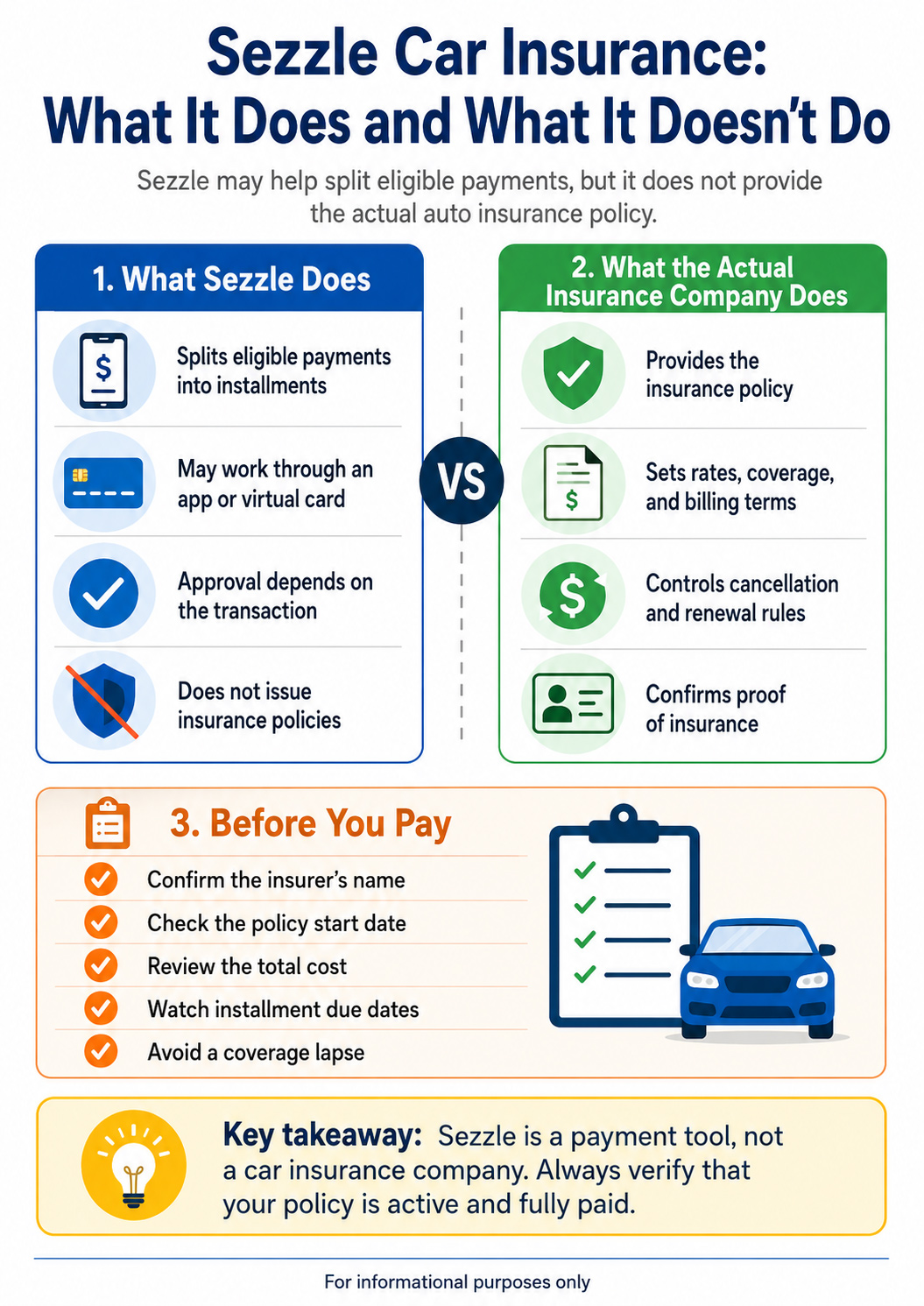
    Sezzle car insurance is a phrase many drivers search when they want coverage without a large upfront payment. The important detail is that Sezzle is not an auto insurance company, does not underwrite policies, and does not decide whether you qualify for coverage. It is a buy now, pay later payment platform that may help split certain eligible purchases into installments.

    That difference matters. Paying with Sezzle, a virtual card, or another BNPL-style method does not replace the need to choose a real insurer, confirm your policy start date, read the billing terms, and keep every payment current. If your goal is simply to lower the amount due today, you should compare Sezzle-style payment flexibility against direct insurer installment plans, no upfront payment car insurance, and broader pay later solutions.

    Not an insurer Payment tool only Approval may vary Policy terms still matter

    Quick answer: You may be able to use Sezzle in some insurance-related payment flows, especially where a virtual card or eligible checkout option is accepted. However, the safest approach is to verify the actual insurance company, down payment, installment schedule, cancellation rules, fees, and proof-of-insurance timing before relying on any BNPL payment method.

    How Sezzle Works for Car Insurance Payments

    Sezzle’s general buy now, pay later model is built around splitting purchases into smaller payments over time. Sezzle’s own materials describe Pay in 4 installment options, and its car insurance page discusses using Sezzle for car insurance-related purchases through the app and a virtual card process. That can sound simple, but auto insurance billing is more complicated than buying a normal retail item.

    With car insurance, the payment method is only one part of the transaction. The insurer or agency still controls the policy terms, underwriting decision, effective date, required down payment, renewal rules, cancellation rules, and proof of insurance. A BNPL approval does not mean the insurance policy itself has been approved, and an insurance quote does not guarantee that every payment method will be accepted.

    In practical terms, Sezzle may be relevant if the checkout flow accepts it directly, if the Sezzle app routes you to an eligible payment option, or if a virtual card can be used where the insurer or agency accepts card payments. Even then, the driver should confirm that the payment successfully posts to the insurance account and that coverage is active before driving.

    Sezzle Is Not the Same as No-Deposit Car Insurance

    One reason the phrase “Sezzle car insurance” can be confusing is that shoppers often use it as a shortcut for “I need car insurance now but cannot pay a large amount today.” Those are related ideas, but they are not identical.

    No-deposit car insurance usually refers to policies marketed with a lower first payment or reduced upfront cost. A direct insurer installment plan is a billing arrangement attached to the insurance policy. Sezzle, by contrast, is a separate payment platform that may or may not work with the transaction you are trying to complete.

    Sezzle or BNPL

    A third-party payment option that may split an eligible transaction into installments. It does not create the insurance policy.

    Insurer Installment Plan

    A payment schedule offered by the insurer or agency. This is usually tied directly to the policy billing system.

    No-Deposit Option

    A marketing term often used for policies with a smaller first payment. The total cost may still be spread over the policy term.

    Infographic explaining that Sezzle may help split eligible car insurance payments but does not provide the actual auto insurance policy.

    When Sezzle Might Make Sense

    Sezzle may be worth considering when you have already compared real auto insurance quotes and simply need a more flexible way to handle the payment. It may also make sense for drivers who are comfortable managing installment due dates and who have verified that the payment method is accepted for the exact transaction.

    For example, a driver may want to avoid putting the full first payment on a high-interest credit card. Another driver may need a short-term budgeting bridge while waiting for a paycheck. In those situations, a BNPL tool can feel helpful. But the driver still needs to make sure the insurance account shows the premium as paid and that there is no delay in coverage activation.

    Drivers who need proof of coverage quickly should also compare dedicated instant coverage options, because speed matters. A payment tool is not useful if the policy is not active when you need it.

    When Sezzle May Be the Wrong Choice

    Sezzle may be a poor fit if you are already struggling to keep up with other bills, if you are unsure whether the payment will be accepted by the insurance company, or if splitting the payment only delays a cost you cannot realistically afford. BNPL can make a payment look smaller, but it does not make the insurance policy cheaper by itself.

    It can also create a timing problem. Your Sezzle installment due dates may not match your insurer’s billing schedule. If a later installment fails, that does not necessarily mean the insurer will wait. Insurance companies can cancel policies for nonpayment according to state rules and policy terms. That is why the safest choice is the one that keeps your coverage active, predictable, and affordable beyond the first payment.

    Sezzle vs. Direct Monthly Car Insurance Payments

    For many drivers, a direct monthly payment plan from the insurer may be simpler than using a third-party BNPL platform. Direct billing usually keeps the payment schedule, policy status, renewal notices, and cancellation notices inside one insurance account. Sezzle may add flexibility, but it also adds another system to monitor.

    Option How it works Main benefit Main risk
    Sezzle or BNPL Splits an eligible payment into installments through a third-party platform or virtual card. Can reduce immediate payment pressure if accepted. May not be accepted by every insurer or may create separate due dates to manage.
    Insurer monthly plan The insurance company bills the premium over the policy term. Usually easier to track because billing is tied directly to the policy. May require a down payment, installment fees, or autopay enrollment.
    Low down payment policy The first payment is reduced, then the remaining premium is billed later. Can help drivers start coverage with less due today. Total premium may still be high, and missing payments can risk cancellation.
    Credit card The policy payment is charged to a card and repaid through the card issuer. May be widely accepted and easy to process. Interest can become expensive if the balance is not paid quickly.

    What to Check Before Using Sezzle for Insurance

    Before using Sezzle or any BNPL method for an insurance-related payment, verify the full payment path. The goal is not just to make a payment go through. The goal is to keep your policy active without surprise fees, failed payments, or a coverage lapse.

    1. Confirm the actual insurer Make sure you know which licensed insurance company is issuing the policy, not just which payment app is being used.
    2. Verify the policy effective date Do not assume you are covered until the insurer confirms the start date and proof of insurance is available.
    3. Check whether the payment method is accepted Some carriers may accept card payments, while others may restrict prepaid, virtual, or third-party payment methods.
    4. Compare total cost Look beyond the first payment. Review installment fees, service charges, late fees, and the full policy premium.
    5. Match due dates to your budget BNPL installments may fall every two weeks, while insurance bills may follow a monthly schedule.
    6. Avoid coverage gaps A failed payment can become serious if it causes cancellation, a lapse, or trouble getting insured later.

    Better Alternatives to Compare First

    If your main concern is affordability, Sezzle should not be the only option you compare. In many cases, the better solution is finding an insurance company or agency that offers a lower first payment, monthly billing, autopay discounts, or a policy structure that fits your budget from the beginning.

    Practical Example: When the Payment Looks Easy but the Policy Still Matters

    Imagine a driver finds a quote with a first payment due today. The driver opens Sezzle, creates a virtual card, and tries to use it during checkout. If the card is accepted and the insurer confirms the policy is active, the driver may have successfully reduced the immediate cash pressure.

    But there are still follow-up responsibilities. The driver must make every Sezzle installment on time. The driver must also watch the insurance account to make sure the payment was posted correctly and that future insurer payments are scheduled. If the BNPL payment fails or the policy billing account shows unpaid premium, the driver could still face cancellation or a lapse.

    That is why Sezzle should be treated as a payment method, not as an insurance solution by itself. The real solution is affordable coverage that stays active month after month.

    Is Sezzle Car Insurance Legit?

    The phrase is partly legitimate and partly misleading. It is legitimate in the sense that Sezzle publicly discusses using its platform for car insurance-related purchases. It is misleading if someone presents Sezzle as the company providing the auto insurance policy.

    A safer way to think about it is this: Sezzle may help with the payment side of an eligible transaction, but your coverage still comes from the insurer. Before paying, confirm the carrier, coverage limits, deductibles, liability protection, policy period, cancellation terms, and renewal expectations.

    Editorial recommendation: Do not choose an insurance option only because the first payment looks smaller. Choose the option that gives you real coverage, clear billing, a manageable total cost, and the lowest risk of cancellation.

    FAQ About Sezzle Car Insurance

    Does Sezzle sell car insurance?

    No. Sezzle is a buy now, pay later payment platform. It does not underwrite auto insurance policies, set insurance rates, or act as your insurance carrier.

    Can I use Sezzle to pay for car insurance?

    Possibly, but it depends on the checkout flow, merchant, insurer, agency, virtual card acceptance, and Sezzle approval. Always confirm that the payment posts successfully and that your policy is active.

    Is Sezzle better than monthly car insurance payments?

    Not always. A direct monthly plan from the insurer may be easier to manage because the billing schedule is tied directly to the policy. Sezzle may help in some cases, but it creates a separate payment schedule to track.

    Can using Sezzle prevent a car insurance lapse?

    Only if the payment is accepted, posted correctly, and followed by all required future payments. A BNPL tool does not remove the risk of cancellation if premiums are not paid according to the policy terms.

    What should I compare before using BNPL for insurance?

    Compare the total premium, down payment, installment fees, due dates, payment method rules, cancellation notice terms, proof-of-insurance timing, and the financial strength of the actual insurer.

    Final Verdict: Use Sezzle Carefully, Not Blindly

    Sezzle can be part of the conversation for drivers who want more payment flexibility, but it should not be treated as a replacement for real insurance shopping. The best option is usually the one that combines affordable coverage, clear billing, reliable proof of insurance, and a payment schedule you can actually keep.

    If Sezzle works for your transaction and does not add extra risk, it may help reduce upfront pressure. If it creates confusion, separate due dates, or uncertainty about whether the policy is active, a direct insurer installment plan or a low-down-payment policy may be safer.

    Compare Pay Later Car Insurance Options

    Before relying on Sezzle or any third-party payment app, compare real insurance options built around flexible billing, lower upfront costs, and clear policy terms.

    Explore Pay Later Solutions

    References

    1. Sezzle: Buy Now Pay Later for car insurance
    2. Sezzle: Buy Now, Pay Later overview
    3. Consumer Financial Protection Bureau: Buy Now, Pay Later market trends and consumer impacts
    4. National Association of Insurance Commissioners: Auto Insurance consumer information